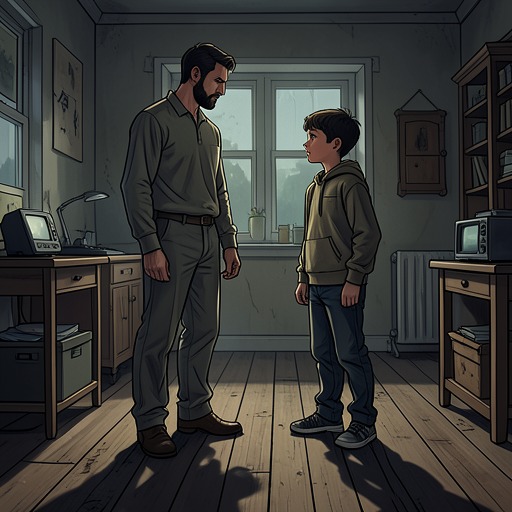
Thobela Mpayipheli and his father Lawrence: estrangement
Heart of the HunterThobela Mpayipheli and his father, Lawrence Mpayipheli, are divided not by a lack of love but by competing understandings of what a life should serve. Lawrence’s Christian commitment to peace makes him try to protect his son; Thobela’s growing attachment to the warrior’s path carries him away from home and into The Struggle. The relationship becomes one of the novel’s clearest reckonings with the cost of opposing ideals within a family, and its final image places father and son near one another again without yet confirming what their reunion will mean.
Identity and Background
Lawrence is a Christian minister whose faith took shape at a mission school. He found in Christianity an expression for convictions he already felt, received a church bursary, studied, married, and became a pastor among his own people in the Kat River Valley. His vocation gives him a language of care, humility, and peace, but it does not grant him control over his son’s choices.
The novel sets Lawrence beside his brother Senzeni, whose commitments point in a sharply different direction. Senzeni is associated with warrior leadership and the liberation movement; Lawrence understands himself as a shepherd, while his brother is drawn to the struggle for freedom. Thobela grows between these models. The contrast makes the family conflict larger than a private disagreement: the brothers’ opposed paths enter the next generation through a boy whom Lawrence hopes to raise in safety and Senzeni believes belongs on another path.
A Son Who Resembles His Father
In Thobela’s early years, his resemblance to Lawrence encourages the belief that he will follow his father’s character as well as his appearance. He inherits Lawrence’s tall build and capacity for a rhythmic, enduring stride across the Ciskei hills. His ability to lead, decide, and judge a matter from several angles also appears to Lawrence as a legacy of family traits. Yet outward likeness proves an unreliable guide to inward direction.
Lawrence is the first to recognize that his son may not share his peacemaking nature. Because he is Senzeni’s brother, he believes he can read the signs of a disposition that draws Thobela toward the warrior’s life. He responds by enveloping the boy in love, hoping to make home a protective enclosure. In retrospect, Lawrence understands that love did not prevent the separation; his devotion also kept him from fully seeing how far his son was changing. The resemblance that initially promised continuity becomes an especially painful measure of their difference.
Senzeni’s Intervention and the Break
The estrangement begins, in Lawrence’s account, with ordinary domestic differences between father and son. It widens gradually, like ripples spreading from a small disturbance. The decisive intervention comes in 1976, during the Soweto uprising, when Thobela is fourteen. Although Senzeni has been forbidden from the house because of his influence, he enters at night and takes the boy away. He has Thobela initiated and brings him to places marked by Xhosa bloodshed, drawing him into a history of struggle that Lawrence fears and cannot offer as his own.
The absence lasts three months. When Senzeni brings Thobela home, Lawrence feels that father and son no longer know one another. They remain in the rectory for two years as strangers: Thobela follows his own paths, quiet and withdrawn, while Lawrence cannot restore the intimacy that existed before. The damage is not described as a single quarrel that can be settled by apology. It is a changed relationship, made visible in shared domestic space that no longer produces a sense of belonging.
In 1979, Thobela leaves again, this time to join the war. The morning after he has said goodnight—a rare gesture—Lawrence finds the room empty, the bed untouched and some clothes gone. Senzeni later confirms that his son has left. Lawrence’s grief turns into anger at his brother and at God: he experiences the departure as the loss of his only son and as a failure of the fatherly role he had tried to fulfil. The few later messages about Thobela bring news of his progress and recognition by leaders of The Struggle, but they do not restore a direct relationship between father and son.
Bereavement, Guilt, and a Changed Understanding
The last message Lawrence recounts concerns Senzeni’s arrest by the Security Police in Grahamstown. Senzeni is killed after eight days in custody, and Lawrence says that the family never hears from Thobela again. The deaths and disappearances around the brothers’ political commitments leave Lawrence with no clear way to reach his son. His account conveys both the force of his attachment and the limits of his knowledge: he can remember Thobela’s departure and receive reports, but cannot tell what becomes of him.
With time, Lawrence reinterprets the experience through his faith. He comes to see his inability to save Thobela as a test that humbled him, exposing the presumption that his own path made him more righteous than others. This reading does not undo his pain or bring his son home. Rather, it changes the meaning Lawrence assigns to his failure: he recognizes the limits of paternal protection and the danger of mistaking love for power over another person’s life.
Thobela’s later insistence that he must repay a debt of honour to Johnny Kleintjes, even after saying he wants to leave violence behind, echoes the conflict at the heart of the family relationship. He frames his choice as a struggle to do what is right, while Lawrence’s history makes visible how choices made in the name of duty can also divide a family. Thobela’s hope of beginning again with Miriam and Pakamile at Cala farm offers a possibility of care and a different future, but it does not erase the years in which Lawrence has been unable to share his life.
The Garden and the Possibility of Return
Near the close of the novel, Lawrence is tending vegetables in Alice when he hears a motorbike before seeing its riders. Two people arrive: a large man and a little boy. Lawrence cannot yet be sure who they are, so he waits for them to remove their helmets. His response is an immediate, quiet prayer, followed by the hope that he will be able to call his wife across the back yards. The scene brings the father’s long separation from his son into the present tense of recognition: a motorbike has carried the possibility of return to the edge of Lawrence’s garden.
The account ends before the riders are identified and before a reunion is confirmed. That restraint matters. The final approach offers neither a simple repair of the past nor proof that Lawrence and Thobela have overcome their estrangement. Instead, it places a father who once tried to make a protective home beside a possible return, with the son’s child also present. After years in which family connection has been interrupted by competing allegiances, departure, and silence, the garden becomes a threshold: the hope of renewed kinship is real, but its future remains open.